
Why Every Minneapolis Online Business Needs a Local SEO Strategy in 2026
You built a solid online business. Your product ships nationwide. Your website looks sharp. Your Instagram is on point.
And yet, someone in Uptown Minneapolis is searching right now for exactly what you sell, and buying it from a competitor in Austin, Texas.
That’s not bad luck. That’s a local SEO problem.
In 2026, Minneapolis-specific search intent has become the single biggest missed opportunity for online businesses operating right here in this city. Google isn’t just a search engine anymore. It’s a proximity machine. It’s a trust filter. And if your Minneapolis online business doesn’t speak the language of local search, you’re funding your competition’s growth while standing on a gold mine.
What “Local SEO” Actually Means for an Online Business
Here’s where most people get confused. They think local SEO in Minneapolis is only for brick-and-mortar shops, the coffee roaster in Northeast Minneapolis, the boutique on Hennepin, the food truck doing rounds near the Chain of Lakes.
Wrong.
Local SEO for online businesses in Minneapolis is about signaling to Google that your business is rooted here, serves people here, and deserves to rank when Minneapolis consumers are searching. Even if you ship product to all 50 states, the customers most likely to trust you, review you, and return to you are within 15 miles of your zip code.
Minneapolis proximity signals, the geo-tagged data Google collects from your website, your Google Business Profile, your local citations, and your customer reviews, tell the algorithm where you live. If those signals are weak or absent, Google assumes you’re nobody local. And it treats you accordingly.
Why 2026 Is the Year Minneapolis Online Businesses Can’t Afford to Wait
Something shifted in late 2024 and accelerated hard through 2025. Google’s AI-powered search features started rewarding hyper-local geo-fencing data in a way that previous algorithm updates never did.
What does that mean in plain English?
When someone in the North Loop searches “best ergonomic desk accessories online,” Google’s AI doesn’t just look at your content. It looks at whether your business has any meaningful Minneapolis footprint, local backlinks, a verified Google Business Profile, Minneapolis-specific landing pages, local schema markup. If you have those signals, you surface. If you don’t, you’re buried under national brands with ten times your ad budget.
This is the 2026 shift toward Predictive Local SEO. Google now anticipates search intent before a user even finishes typing, using behavioral patterns tied to location. Minneapolis consumers search differently than consumers in Phoenix or Philadelphia. Our winters reshape buying behavior, there’s a documented spike in online purchasing from November through February here that local businesses can capture if their local SEO infrastructure is built to meet it.
If your Minneapolis search engine optimization strategy isn’t accounting for seasonal search behavior, you’re leaving significant Q4 revenue on the table every single year.
The AI-Driven Hyper-Local Discovery Problem (And Opportunity)
Let’s talk about AI-Driven Hyper-Local Discovery, one of the defining forces reshaping SEO Minneapolis strategies in 2026.
Google’s AI Overviews and ChatGPT’s browsing features are now actively pulling local business recommendations into zero-click search results. A Minneapolis consumer asks an AI assistant “where can I order locally-made skincare products?” and the AI surfaces a short list of businesses, without the user ever clicking a single link.
These are called zero-click searches. And they’re growing fast.
The businesses that appear in those AI-generated recommendations share one thing in common: strong, consistent local SEO signals. Their Google Business Profile is fully optimized and regularly updated. Their website mentions Minneapolis neighborhoods, local landmarks, local partnerships. Their reviews are recent, plentiful, and geographically relevant.
Here’s the brutal truth: if you’re not building these signals into your SEO Minneapolis 2026 strategy right now, you won’t just miss organic traffic. You’ll miss the AI-recommendation layer entirely, and that layer is where a growing percentage of Minneapolis purchase decisions are being made.
Minneapolis Consumer Behavior: What the Data Tells Us
Minneapolis isn’t just another mid-sized American city. It has a distinct consumer culture that rewards local authenticity.
University of Minnesota research and local commerce data consistently show that Twin Cities consumers are above-average in their preference for locally-rooted businesses, even when shopping online. A Minneapolis shopper who discovers your business through a local search result is significantly more likely to convert and to leave a review than a shopper who finds you through a generic national ad.
That’s the compounding power of why local SEO matters in MN. Every local citation, every Minneapolis-tagged piece of content, every geo-specific landing page you build isn’t just helping you rank today. It’s building a trust asset that compounds over time, making future rankings easier and future conversions cheaper.
Northeast Minneapolis has seen an explosion of small online businesses since 2022. The competition for local search real estate is real and growing. Businesses that invested in local SEO two years ago are reaping the benefits now. The ones who wait another year will be paying twice the effort to catch up.
The Five Local SEO Moves Every Minneapolis Online Business Should Make Now
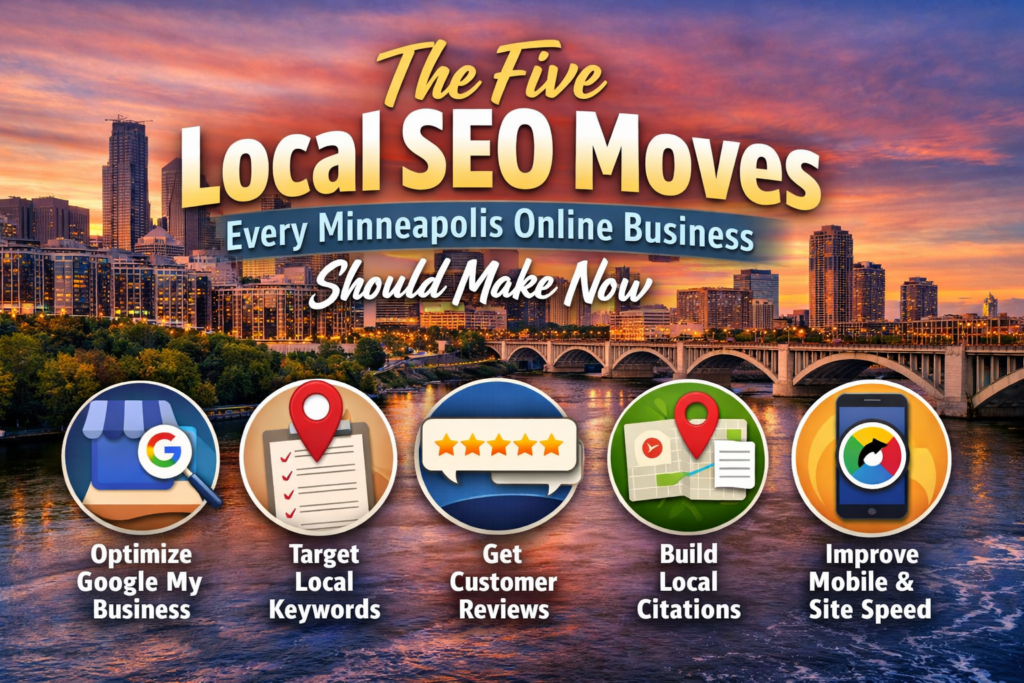
You don’t need to rebuild everything overnight. Start with these five high-impact actions.
1. Claim and fully optimize your Google Business Profile. This is non-negotiable. Add your Minneapolis address (even if you’re home-based, use a service-area designation), upload real photos, post weekly updates, and respond to every review. This single asset drives more local discovery than most people realize.
2. Build Minneapolis-specific landing pages. Create content that speaks directly to Minneapolis customers. Reference specific neighborhoods. Mention local pain points. If you sell cold-weather gear, write about preparing for a Minnesota January. Specificity signals local authority to both Google and real humans.
3. Earn local backlinks. Get listed in Minneapolis business directories. Partner with local bloggers, chambers of commerce, and neighborhood organizations. A backlink from the Minneapolis Regional Chamber carries genuine local SEO weight that a generic directory listing never will.
4. Implement local schema markup. This is technical, but your web developer can handle it in an afternoon. Local business schema tells Google’s crawlers exactly who you are and where you operate. It directly improves your chances of appearing in structured snippets and AI-generated recommendations.
5. Prioritize review velocity. Ask Minneapolis customers for reviews consistently. Recent reviews with Minneapolis-specific language (neighborhood mentions, local context) send powerful proximity signals. Don’t batch-ask for reviews once a year. Build it into your post-purchase flow permanently.
FAQ: Local SEO for Minneapolis Online Businesses
Q1: Does local SEO really matter if my online business ships nationally?
Yes, and significantly so. Even national-shipping businesses see higher conversion rates from local customers who discover them through local search. Minneapolis proximity signals also help establish baseline trust credibility that improves your overall domain authority and ranking performance across all geographic markets.
Q2: What is a Google Business Profile and does an online-only business need one?
A Google Business Profile is a free listing that appears in Google Search and Google Maps. Online businesses without a physical storefront can still create a profile using a service-area designation. In 2026, this profile functions as a critical local trust signal and directly influences whether your business appears in AI-generated local recommendations and zero-click search results.
Q3: How is Minneapolis-specific search intent different from general SEO targeting?
Minneapolis-specific search intent refers to the behavioral patterns, seasonal cycles, and local terminology Minneapolis consumers use when searching. Minneapolis SEO strategy accounts for these patterns, seasonal buying surges, neighborhood-specific searches, and local trust preferences, in ways that generic national SEO strategies do not. Targeting this intent puts your business in front of high-converting local traffic that national competitors are not optimized to capture.
Q4: How long does it take for local SEO efforts to show results in Minneapolis?
Most Minneapolis businesses see measurable improvement in local search visibility within 60 to 90 days of consistent local SEO implementation. Google Business Profile optimizations often produce results faster, sometimes within 2 to 4 weeks. The compounding benefits of local citations, local backlinks, and optimized content continue to build over 6 to 12 months, making early investment significantly more valuable than delayed action.
The Minneapolis Market Won’t Wait For You
Here’s the bottom line.
Minneapolis is a city that rewards businesses that show up, really show up, for the local community. That’s true on Lake Street. It’s true in St. Anthony Main. And in 2026, it’s true in Google search results.
Your competitors are either already building their local SEO infrastructure or they’re about to start. The window to build an early advantage in Minneapolis search engine optimization is narrowing.
Your online business has Minneapolis roots. It’s time Google knew it too.
Start with your Google Business Profile. Build one Minneapolis-specific landing page. Ask your last ten customers for a review. Do those three things this week and you’ve already moved further than 80% of your local competition.
That’s not a small thing. That’s the beginning of owning your market.