
What Is 3PL and Why Every Minneapolis Ecommerce Business Should Consider It in 2026
You started in your basement. Bubble wrap on the floor. USPS pickup at 4:30 PM sharp. Orders were manageable, maybe 20 a day.
Then you hit a growth wall.
Not because demand died. Because your fulfillment couldn’t keep up with it. Sound familiar? You’re not alone. Hundreds of Minneapolis e-commerce founders hit this exact ceiling every year, and the ones who break through it do one thing differently. They stop treating warehousing and shipping as a DIY project.
They move to a 3PL model. And they don’t look back.
What Is 3PL, Actually? (No Fluff, Just the Reality)
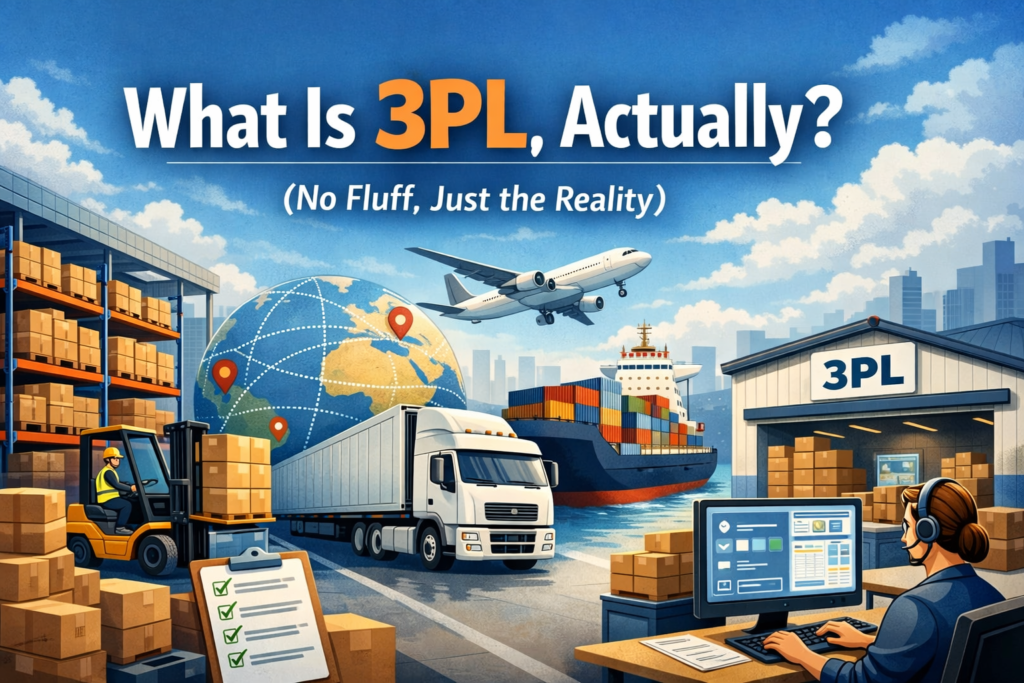
3PL stands for Third-Party Logistics. It’s the practice of outsourcing your warehousing, pick-and-pack, and shipping operations to a specialized provider, one whose entire business is built around moving your product faster, cheaper, and more accurately than you can do it yourself.
When you partner with a 3PL for small business in Minneapolis, here’s what actually happens: your inventory ships to their facility (often multiple facilities across the region or country). When a customer orders, their team picks it, packs it, labels it, and hands it to the carrier, usually within hours, not days.
You log into a dashboard. You see what moved. You go build your brand.
That’s the model.
And for Minnesota-based e-commerce brands shipping to the upper Midwest, the Pacific Northwest, and the coasts, the geography of a well-placed 3PL matters more than most founders realize.
Why Minneapolis Is a Logistics Goldmine Most Brands Ignore

Minneapolis sits at a rare intersection. It’s a major rail hub, a multi-carrier air freight market, and close enough to Chicago’s intermodal ramps to take advantage of drayage from Chicago rail ramps, one of the most cost-effective ways to move high-volume inbound freight before it enters your fulfillment pipeline.
Think about it this way. If you’re importing product from Southeast Asia or Mexico and it’s arriving by container, rail drayage from Chicago to Minneapolis can cut your inbound freight cost significantly compared to air or direct truck. For brands doing over $1M in annual product moves, this isn’t a logistics footnote. It’s a margin line.
The Twin Cities also has a dense carrier network. FedEx, UPS, USPS, and regional carriers like Spee-Dee all operate major hubs or service lanes here. That means a 3PL based in Brooklyn Park, Eagan, or Fridley can get your product to 85% of the U.S. in two days ground, without you paying for two-day air.
That’s the Minneapolis advantage. Most brand owners who are still self-fulfilling from a lease in Northeast Minneapolis or a rented bay in St. Louis Park are leaving that advantage completely on the table.
The Real Cost of Not Outsourcing Fulfillment in Minnesota
Here’s where we need to be straight with you.
The cost of not moving to third party logistics Minnesota isn’t just the hours you spend packing boxes. It’s inventory distortion, a creeping, compounding problem where your actual stock counts drift from your system counts. Oversells. Stockouts. Customer complaints. Refund cycles.
Inventory distortion costs the global retail industry over $1.7 trillion annually. For a Minneapolis brand doing $500K to $3M in annual revenue, even a 5% distortion rate is quietly killing your profitability.
Professional 3PL operations run tight Inventory Management Systems (IMS), software that syncs in real time with your Shopify, WooCommerce, or BigCommerce storefront. Every unit received is scanned. Every unit shipped is logged. Cycle counts run on schedule. You stop flying blind.
You also stop absorbing the full cost of labor. Warehouse wages in the Twin Cities metro have risen consistently. When you outsource fulfillment MN, you shift from fixed labor overhead to a variable cost model, you pay for what ships. That’s a fundamentally different financial structure, and it gives early-stage and mid-market brands the flexibility to survive slow seasons without bleeding on payroll.
Predictive Inventory Placement: The 2026 Strategy Minnesota Brands Need Now
This is where 3PL gets genuinely strategic, not just operational.
Smart 3PL providers aren’t just warehouses. They’re data partners. And the leading ones are already moving toward predictive inventory placement, a model where your stock isn’t sitting in one static location waiting to be shipped. Instead, it’s distributed across multiple nodes based on your historical order data, zip code demand patterns, and seasonal velocity curves.
For Minnesota brands, this is especially critical. If your customer base is concentrated in the upper Midwest, the Twin Cities suburbs, Duluth, Rochester, Madison, Des Moines, you don’t need your inventory staged in Phoenix or Atlanta. You need it close. A 3PL network that places product in Minneapolis and Chicago simultaneously can give you next-day or same-day economics without you running your own multi-facility infrastructure.
The brands that will dominate their categories in 2026 are the ones making these placement decisions now. Not reactively, after they’ve already lost customers to faster competitors. Proactively, based on data.
Ask your 3PL partner: do you offer distributed inventory placement? Do you analyze my order history to recommend node positioning? If they look at you blankly, that’s your answer.
Hyper-Local Same-Day Delivery in Minneapolis: It’s Closer Than You Think
Amazon has trained your customers. Same-day delivery is no longer a premium expectation, it’s increasingly a baseline one.
For Minneapolis e-commerce brands, hyper-local same-day delivery is achievable right now. Not in some hypothetical future. Today.
The infrastructure is here. Delivery platforms, regional courier networks, and 3PL providers with last-mile partnerships can pull same-day windows across the 7-county metro, Hennepin, Ramsey, Dakota, Anoka, Washington, Scott, and Carver counties. If your 3PL has a facility positioned centrally in the metro, you can offer same-day or next-morning delivery to a substantial chunk of your customer base.
Minnesota’s climate adds a wrinkle most coastal logistics consultants miss. January in Minneapolis is not January in Austin. Last-mile delivery here requires carriers equipped for snow routes, vehicle maintenance schedules built around freeze-thaw cycles, and packaging protocols that account for temperature extremes, especially relevant if you’re moving food, cosmetics, or electronics.
The right 3PL partner in the Twin Cities has already solved for this. They’ve built carrier relationships with drivers who know these routes. They’ve invested in heated dock facilities. They’re not figuring it out in real time during a February polar vortex, because they’ve been doing this for decades.
That operational depth is what you’re buying when you choose a local 3PL over a national drop-ship aggregator with no Minnesota footprint.
A Note on Section 321 Shipments and Cross-Border Inventory
If any portion of your product line is sourced from Canada or involves lower-value SKUs imported internationally, Section 321 shipments are worth understanding before your 3PL conversation.
Section 321 of the U.S. Tariff Act allows goods valued under $800 to enter the U.S. duty-free on a per-shipment, per-day basis. For e-commerce brands with Canadian supplier relationships, not uncommon for Minnesota brands given the proximity to the border, a 3PL with cross-border fulfillment capability can structure your inbound flow to legally reduce your customs duty exposure.
This isn’t a workaround. It’s a compliant, established trade mechanism. But it requires a 3PL that knows how to execute it. Not all of them do. Ask specifically.
FAQ: What Minneapolis Ecommerce Founders Ask Us Most
Q: What is 3PL and how does it work for small ecommerce businesses in Minneapolis?
A 3PL (Third-Party Logistics) provider stores your inventory in their warehouse, then picks, packs, and ships orders on your behalf when customers buy from your store. For small Minneapolis e-commerce businesses, this means you eliminate the need for your own warehouse space, staffing, and shipping accounts, replacing fixed overhead with a per-order variable cost model that scales with your revenue.
Q: How much does outsourcing fulfillment cost for a Minnesota-based ecommerce brand?
3PL pricing in Minnesota typically includes receiving fees, monthly storage (charged per pallet or bin), pick-and-pack fees per order, and outbound shipping (usually at carrier-negotiated rates the 3PL passes through). For brands shipping 200 to 2,000 orders per month, total fulfillment cost commonly runs between $4 and $9 per order depending on item size, weight, and packaging complexity. Most brands find this is equal to or less than their true all-in self-fulfillment cost once labor is honestly accounted for.
Q: What’s the difference between a 3PL and a fulfillment center for ecommerce?
A fulfillment center is a type of 3PL, specifically focused on direct-to-consumer order processing rather than B2B pallet distribution. All fulfillment centers are 3PLs, but not all 3PLs specialize in e-commerce. For Minneapolis brands selling on Shopify or Amazon, you want a 3PL with a fulfillment center operation, one with direct integrations to your sales channels, not just freight management software.
Q: When is the right time for a Minneapolis ecommerce brand to switch to a 3PL?
The clearest signals are: you’re spending more than 10 hours per week on fulfillment tasks, your order error rate is above 2%, you’ve missed peak capacity (think holiday season or a viral moment) due to warehouse constraints, or you’re turning down wholesale or retail channel opportunities because you can’t handle the volume. If any two of these are true simultaneously, the conversation with a 3PL should happen this quarter, not next year.
The Bottom Line for Minneapolis Brand Owners
Third-party logistics Minnesota isn’t just a cost center you outsource when you get big enough. It’s a growth lever you pull to get big enough.
The brands scaling fastest in the Twin Cities market right now aren’t the ones with the best products alone. They’re the ones who made the operational decision to stop being their own warehouse manager, and started acting like the brand CEO they actually are.
Your fulfillment operation either supports your growth or limits it. There’s no neutral middle ground.
If you’re still packing boxes yourself, or managing a lease that’s tying up capital you could deploy on inventory, paid acquisition, or product development, the math on 3PL is almost certainly in your favor.
Get a fulfillment audit. Run the real numbers. Then decide.