When Your Storefront Is on Nicollet Mall and Your Warehouse Is Freezing in 55413
January in Minneapolis is not romantic for retail.
Your pipes are stressed, your delivery driver called out, and your Shopify store is the only thing between you and a dead quarter. That’s not hypothetical. That’s Tuesday for a lot of North Loop boutique owners and Northeast Minneapolis makers trying to scale from local darling to regional powerhouse.
Here’s the hard truth: most Shopify themes were built for someone in Santa Monica. Bright, breezy, assumes free two-day shipping is a given and your customer is browsing from a beach chair.
Your customer is browsing from a Subaru idling on Hennepin Ave waiting for a plow to clear the intersection. They need fast load times, frictionless mobile checkout, and a store that feels like it was built for them, not transplanted from a Shopify template dumping ground.
This is what separates Minneapolis brands that grow from ones that stall. The right Shopify theme for your Minnesota online store design isn’t just about aesthetics. It’s infrastructure.
Let’s break it down.
Why Minneapolis Retail Has a Different Digital Baseline in 2026
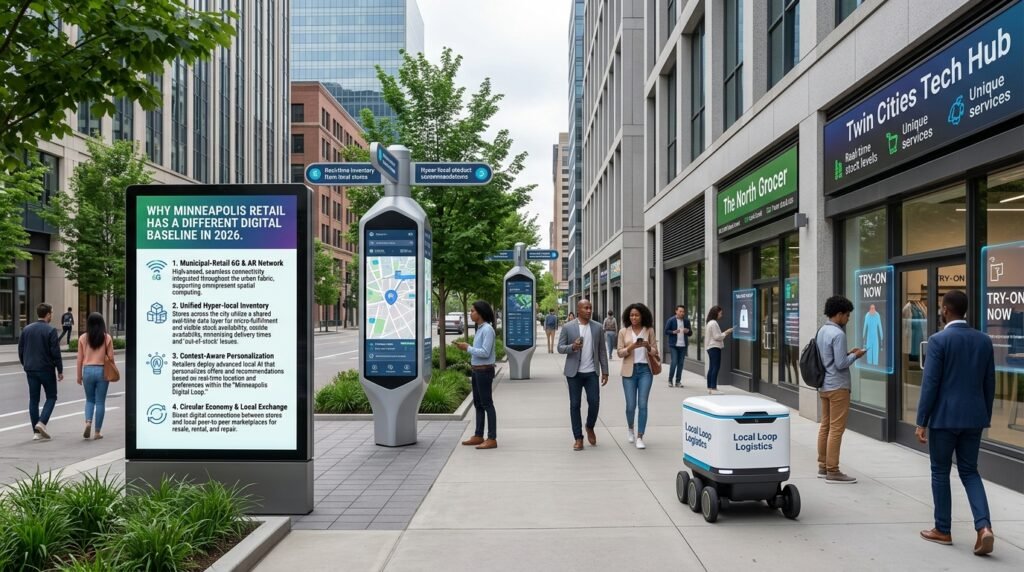
The Minneapolis-St. Paul retail market is not homogenous.
You’ve got the sophisticated foot traffic of Linden Hills running parallel to the industrial-cool, high-ticket consumer base of the North Loop. Northeast Minneapolis has an entirely different buyer psychology, artist-adjacent, community-loyal, skeptical of anything that looks too corporate. Edina is another animal entirely.
A cookie-cutter theme ignores all of that.
Minneapolis SEO trends in 2026 are pushing hard toward localized 1st-party data strategies. Google’s search algorithm increasingly rewards stores that demonstrate hyper-local relevance, neighborhood-level content, MSP logistics transparency, and schema markup that speaks directly to where buyers actually are. A theme that doesn’t support structured data out of the box is already behind.
North Loop retail tech is accelerating. Brands in the North Loop are integrating Shopify POS systems with in-store experiences in ways that require themes with native POS compatibility, not bolt-on workarounds. If your online store and your physical retail presence aren’t sharing data, you’re burning margin.
Hennepin County tax configurations add another layer. You need a theme built on a Shopify infrastructure that handles tax zones cleanly, because a misconfigured checkout in a Minneapolis-St. Paul regional shipping context will cost you real money in chargebacks and abandoned carts.
The 5 Best Shopify Themes for Minneapolis Retail Businesses
1. Dawn, The Reliable Workhorse for North Loop Minimalists
Dawn is Shopify’s flagship free theme, and it earns its place here.
It’s clean, performance-first, and scores exceptionally well on Core Web Vitals, which matters because Minneapolis SEO trends in 2026 are deeply tied to page experience signals. If you’re running a product-focused brand out of the North Loop and you want something that doesn’t get in the way of your product photography, Dawn is a serious starting point.
It supports Shopify POS integration natively. For Minneapolis retailers running both a physical location and an online store, that real-time inventory sync is not optional, it’s operational survival.
The limitation: Dawn is minimal by design. If your brand requires strong editorial storytelling, say, you’re a Northeast Minneapolis maker who needs to explain the process behind your ceramic work, you’ll outgrow it fast.
2. Prestige, Built for the Buyer Who Researches Before They Buy
Minneapolis buyers are educated consumers.
Prestige is a premium theme that prioritizes brand storytelling without sacrificing conversion rate. Long-scroll layouts, editorial-quality image sections, and built-in support for product metafields make it a strong fit for specialty retailers in Edina, Linden Hills, or the boutique corridor of 50th & France.
It handles Hennepin County tax configurations cleanly through Shopify’s native tax engine. No custom code gymnastics required.
For Minnesota online store design with an emphasis on premium positioning, Prestige is consistently one of the highest-converting options in our market. The investment is around $350. It pays back fast if your average order value clears $75.
3. Impulse, For the Minneapolis Retailer Who Moves Volume
If you’re fulfilling orders out of a warehouse in the 55413 or 55418 zip codes, you need a theme built for catalog depth.
Impulse handles large product catalogs without degrading mobile performance. Advanced filtering, promotional banners, and countdown timers are baked in. These aren’t luxuries, they’re conversion mechanics that matter when you’re running a January clearance event and your customer is making a quick purchase decision between two red lights on Central Ave.
Impulse also supports MSP logistics integrations cleanly. When you’re connecting third-party fulfillment tools, ShipBob, ShipHero, or a local 3PL partner, theme-level performance stability is critical. A slow theme breaks the handoff.
The AI-personalization tools Shopify is rolling out through its Storefront API in 2026 are best leveraged on themes like Impulse, where section architecture is flexible enough to support dynamic content blocks without a full rebuild.
4. Broadcast, The Northeast Minneapolis Creative’s Choice
Northeast Minneapolis is not the North Loop. Don’t dress it like it is.
Broadcast is cinematic, content-heavy, and designed for brands where the story is the product. Full-screen video headers, editorial content blocks, and a layout language that signals craft and intentionality. If you’re a Minneapolis independent retailer whose brand equity lives in the “why” behind what you sell, Broadcast converts that narrative into revenue.
It integrates cleanly with localized 1st-party data capture tools. Email and SMS flows built on Klaviyo, connected to a Broadcast-powered Shopify store, allow you to segment by behavior and geography. Minneapolis-St. Paul regional shipping audiences behave differently than national audiences. Your retention stack should reflect that.
5. Warehouse, For the Industrial Fulfillment-Forward Operation
Some Minneapolis retailers aren’t boutiques. They’re operations.
Warehouse is a Shopify theme built for high-SKU environments with a rugged, utilitarian aesthetic that actually works for industrial and equipment-adjacent product categories. If you’re based in the Mid-City Industrial area or running a specialty supply business, Warehouse gives you catalog power without the bloat.
It’s not glamorous. It’s not trying to be. But it loads fast, filters deep, and supports the structured data markup that feeds into predictive SEO strategies, which is where Minneapolis online retail is heading hard in 2026.
Predictive SEO and AI Personalization: What Minneapolis Retailers Need to Know for 2026
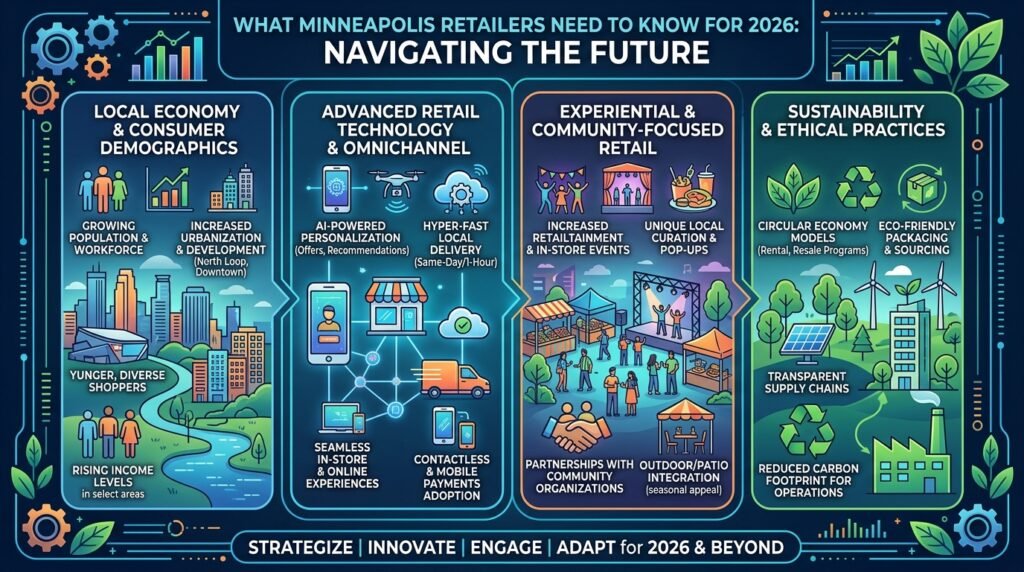
This is where the conversation shifts from picking a theme to building a system.
Predictive SEO is the practice of optimizing for search intent before it peaks, using historical data, seasonal patterns, and behavioral signals to position your store ahead of demand. For Minneapolis retailers, this means understanding that search volume for “winter gear Minneapolis” starts climbing in late September, not November. Your theme needs to support fast content publishing, dynamic collection pages, and clean schema output to capture that window.
AI personalization through Shopify’s native tools is accelerating in 2026. Themes that support Shopify’s Storefront API and headless-compatible section architecture give Minneapolis retailers the ability to serve dynamic product recommendations based on browsing history, purchase patterns, and geographic signals. A customer in St. Paul browsing your store on a Thursday night sees a different homepage than a customer in Eden Prairie on a Saturday afternoon.
That’s not science fiction. That’s available now, if your theme architecture supports it.
The best Shopify themes for Minneapolis retail in 2026 are the ones that don’t just look good at launch. They’re built to handle the integrations, data flows, and performance requirements that a real MSP logistics operation demands.
FAQ: Minneapolis Shopify Themes
Q1: What is the best Shopify theme for a Minneapolis retail business in 2026?
The best Shopify theme for a Minneapolis retail business depends on your catalog size and brand positioning. For volume-driven retailers, Impulse leads. For premium or boutique brands, Prestige delivers stronger editorial conversion. For creative-forward brands in neighborhoods like Northeast Minneapolis, Broadcast performs well. All three support Shopify POS integration for hybrid retail models.
Q2: Do Shopify themes handle Minnesota sales tax and Hennepin County tax configurations automatically?
Shopify’s tax engine handles Minnesota state sales tax and Hennepin County configurations natively, but only if your store location and tax settings are correctly mapped during setup. The theme itself doesn’t manage tax logic, but themes with clean checkout architecture reduce the cart abandonment that misconfigured tax displays often cause. Always verify your Minneapolis-St. Paul regional shipping zones in Shopify’s tax settings panel.
Q3: How does my Shopify theme affect local Minneapolis SEO performance in 2026?
Theme choice directly impacts Core Web Vitals scores, load speed, layout stability, and interactivity, which are ranking factors in Google’s 2026 algorithm. Themes with bloated code or unoptimized image loading hurt your Minneapolis SEO rankings. Choose a theme with clean schema support, fast mobile rendering, and flexible metadata fields. These elements feed directly into local search visibility for searches like “best Shopify themes Minneapolis” and “Minnesota online store design.”
Q4: Can a Minneapolis Shopify expert help me choose and customize the right theme for my store?
Yes. A local Minneapolis Shopify specialist understands the specific operational realities of MSP retail, from Hennepin County tax setup to MSP logistics integrations to the seasonal demand patterns that affect North Loop retail tech planning. Working with someone embedded in the Minneapolis market means your theme customization is aligned with local buyer behavior, not a generic national template.
The Bottom Line for Minneapolis Retailers
Your Shopify theme is not decoration. It’s the front line of your revenue operation.
The brands winning in the Minneapolis market right now, in the North Loop, in Northeast, along the corridors of South Minneapolis, are the ones who stopped treating their online store like a digital brochure and started treating it like a conversion engine.
Pick a theme built for your volume, your brand, and your buyers. Configure it for Minnesota online store design realities. Connect it to your POS, your fulfillment stack, your email and SMS retention flows.
And if you’re staring at a frozen warehouse in 55413 wondering why your cart abandonment rate is 74%, it’s time to talk to someone who knows this market.
A Minneapolis Shopify expert can audit your current setup, recommend the right theme for your operation, and build out the integrations that turn MSP logistics complexity into a competitive advantage.
The store that loads fast and converts clean wins. Every time.