Stop Losing Sales to Chicago and Coast Brands. Minneapolis Ecommerce is Your Competitive Edge.
It’s January. Again.
Your 55413 warehouse is sitting at 34 degrees because the heating unit decided to quit on a Tuesday during a wind chill advisory. You’ve got 200 units of product that need to ship before Friday. Your website is a three-year-old Wix page that still says “coming soon” on the about page. And somewhere in Austin, a Shopify brand with zero local credibility is outranking you for searches your customers in Uptown and Eden Prairie are making right now.
That’s the real cost of waiting.
Minneapolis business owners are not lacking hustle. You’ve survived the supply chain chaos, the Nicollet Mall construction cycles, the post-pandemic retail reset. What most are still missing is a scalable, locally optimized Shopify store that converts. This is how you build one in 2026.
Why Shopify Still Wins for Minneapolis Ecommerce in 2026
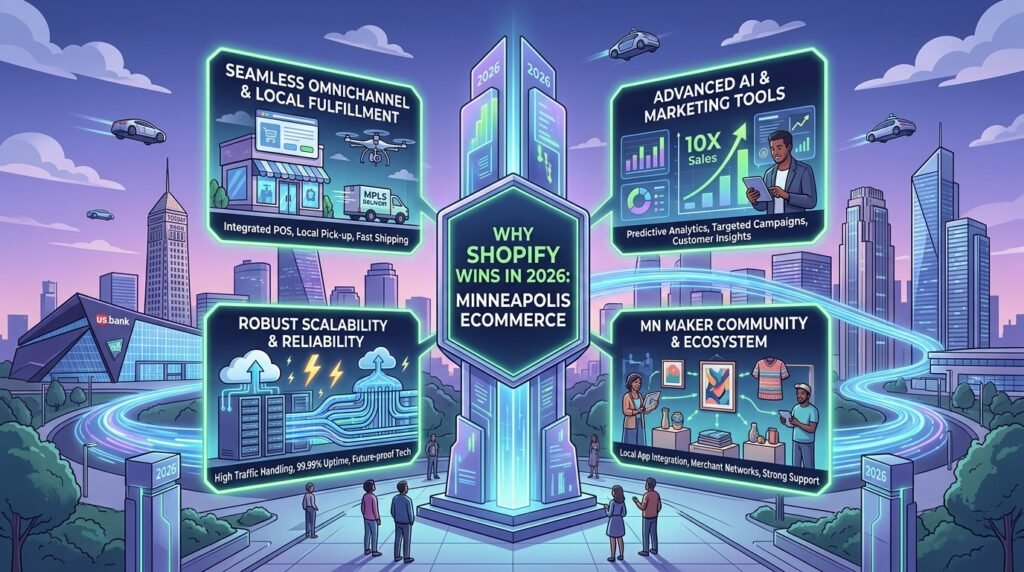
You have options. WooCommerce, BigCommerce, Squarespace, a custom build. But for a Minneapolis business owner who needs to move fast, connect with MSP logistics partners, and scale without hiring a dev team, Shopify is still the sharpest tool on the shelf.
Here’s the practical reality.
Shopify’s POS integration in Minneapolis is a serious asset. If you’re running a physical retail presence in the North Loop or a pop-up at the Midtown Global Market, Shopify’s point-of-sale system syncs your in-store and online inventory in real time. No spreadsheet reconciliation at midnight. No overselling a product you already moved at a Saturday market.
Shopify also connects cleanly with the regional 3PL and fulfillment infrastructure that Minneapolis-St. Paul businesses actually use. Whether you’re working with a fulfillment partner in the MSP logistics corridor along I-94 or shipping direct from your Northeast Minneapolis studio, the platform’s carrier integrations, FedEx, UPS, USPS, and regional last-mile options, are built for operational efficiency, not just coastal use cases.
For 2026, the platform’s AI-native features are no longer optional. They are the baseline.
Step-by-Step: Shopify Store Setup for Your Minneapolis Business
1. Start with the Right Plan and Store Architecture
Don’t default to Basic Shopify because it looks affordable. Map your actual needs first.
If you’re running B2C product sales with under 50 SKUs and no wholesale channel, Basic works. If you’re a Minneapolis-based brand with a retail location, a wholesale arm selling to boutiques on Grand Avenue in St. Paul, and an online DTC channel, you need Shopify’s Advanced tier or Shopify Plus.
Get the architecture right before you build anything.
Your store structure should reflect how Minneapolis customers actually search. That means product category pages built around local intent. “Handmade ceramics Minneapolis.” “Sustainable apparel North Loop.” These are not vanity keywords. They are high-intent, lower-competition search terms that national brands cannot authentically own.
2. Configure Hennepin County Tax Settings Correctly
This is the step that trips up most new store owners. Skip it and you will spend hours fixing it later.
Minnesota has a 6.875% state sales tax. Minneapolis adds a city rate. Hennepin County layers on top of that. Shopify’s tax engine can handle this automatically, but you must configure it correctly from the start. Use Shopify’s built-in tax settings, set your nexus to Minnesota, and enable automatic rate calculation.
If you’re selling into St. Paul, Bloomington, or other Metro cities, verify that your tax settings account for the varied local rates across the Minneapolis-St. Paul region. A tax professional familiar with Minnesota ecommerce law is worth the consultation fee before you launch.
3. Build for Minneapolis SEO Trends in 2026
Minneapolis SEO in 2026 is no longer just about keywords. It’s about signals.
Google’s ranking systems now weight what practitioners call predictive SEO, your ability to anticipate what a user wants next based on behavioral patterns, not just what they typed. For a Minneapolis ecommerce brand, that means creating content clusters around local buyer journeys. Not just a product page. A full path: neighborhood guide, product use case, comparison, social proof from recognizable local voices.
AI personalization is now table stakes. Shopify’s native features, combined with apps like Rebuy or LimeSpot, allow you to serve personalized product recommendations based on browsing behavior, location signals, and purchase history. A customer in Linden Hills browsing your site at 7pm on a Thursday has different buying intent than a customer in the North Loop hitting the same page at 11am on a Monday.
Treat them differently.
For localized 1st-party data, use Shopify’s built-in email capture tools, loyalty program integrations, and post-purchase surveys. Build your own customer data asset. Paid traffic costs are not going down. Your email and SMS list is the only acquisition channel you fully own.
4. Set Up MSP-Relevant Shipping and Fulfillment
Minneapolis-St. Paul regional shipping has its own rhythm. Plan for it.
Winter is not a season. It is a logistics variable. Ground shipping times from MSP to the northern suburbs or outstate Minnesota can shift significantly during January and February weather events. Set customer expectations at checkout. Use Shopify’s estimated delivery date apps to show realistic timelines.
Build relationships with local fulfillment options. Several 3PL providers operate within the MSP metro specifically to serve ecommerce brands that need same-day or next-day delivery to Twin Cities customers. If you’re shipping high volumes of product from a Mid-City Industrial warehouse, those local partnerships are worth more than the cheapest national rate.
Set up shipping zones in Shopify that reflect Minnesota geography. Local pickup should be an option if you’re in a neighborhood with foot traffic. Northeast Minneapolis brands especially, the customer who buys online and picks up at your studio is a different customer relationship than the one who gets a brown box dropped on their porch.
5. Design for Conversion, Not Just Aesthetics
Your store needs to convert. That’s the only metric that matters.
Choose a Shopify theme built for speed. Google’s Core Web Vitals scores now affect organic ranking. A slow-loading theme is an SEO problem, not just a UX problem. Themes like Dawn, Prestige, or Impulse are solid starting points for Minneapolis brands that want clean performance without heavy custom development.
Use real photography. Minneapolis customers can tell the difference between a stock photo and an image shot in an actual local context. If your product is used outdoors, shoot it at Theodore Wirth Park in late fall. If it belongs in a kitchen, shoot it in a kitchen that looks like it belongs in Kingfield or Longfellow. Authenticity converts.
Add trust signals specific to your market. A Minneapolis business address. A local phone number. Reviews from customers who reference real local context. These details create buying confidence for customers who want to support local and need a reason to choose you over a national Amazon listing.
The North Loop Retail Tech Stack Minneapolis Brands Are Using in 2026
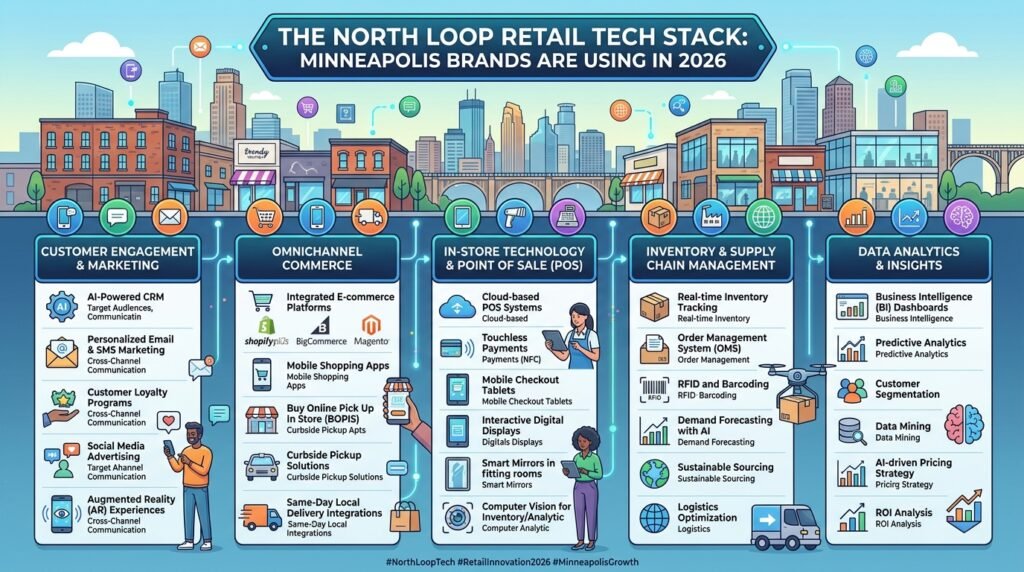
The serious Minneapolis ecommerce operators aren’t just using Shopify out of the box. They’re building a lean, connected stack.
Klaviyo for email and SMS. Gorgias for customer support. Postscript or Attentive for mobile-first retention. A review platform like Okendo or Judge.me. Shopify Markets for any brand expanding into Canadian customers, a real opportunity given MSP’s cross-border trade relationships.
Keep it lean. Every app is a potential site speed drag. Audit your stack every quarter.
FAQ: Shopify Store Setup Minneapolis
How much does it cost to set up a Shopify store for a Minneapolis business?
Shopify plans start at $39 per month for Basic. A professional Shopify store setup for a Minneapolis business, including custom theme configuration, Hennepin County tax setup, product uploads, and MSP shipping configuration, typically ranges from $1,500 to $8,000 depending on complexity. Ongoing costs include apps, transaction fees, and marketing.
Do I need a local Shopify expert in Minneapolis or can I do it myself?
You can build a basic store yourself using Shopify’s setup wizard. If you have more than 100 SKUs, a physical retail location, wholesale channels, or Minneapolis SEO goals, working with a local Shopify expert saves time and prevents costly structural mistakes. A local partner understands the Minneapolis market context that a generic agency doesn’t.
How do I handle Minnesota sales tax on Shopify?
In Shopify, go to Settings > Taxes and Duties. Set your tax nexus to Minnesota. Enable automatic rate calculation. Shopify will apply the combined state, county, and city rates for each Minneapolis-area order automatically. Consult a Minnesota CPA to confirm your filing obligations if you’re generating significant sales volume.
What’s the best Shopify theme for a Minneapolis retail brand in 2026?
For Minneapolis retailers, Dawn is the best free option, fast, clean, and highly customizable. For premium options, Prestige works well for lifestyle and apparel brands common in neighborhoods like the North Loop and Linden Hills. Impulse is strong for stores with larger catalogs. Prioritize Core Web Vitals performance scores over visual complexity.
Ready to Build Your Minneapolis Ecommerce Store?
Your competition is already on Shopify. Some of them are doing it well. Most of them are leaving serious local SEO and retention revenue on the table because they set up their store like a national brand instead of a Minneapolis business.
You know this market. You know your customers. The right Shopify setup amplifies that advantage instead of erasing it.
If you’re a Minneapolis business owner ready to start Shopify business Minneapolis the right way, with proper Hennepin County tax configs, MSP logistics integrations, and a 2026 SEO strategy built for your neighborhood, let’s talk.
Local expertise. Real results. No coast required.