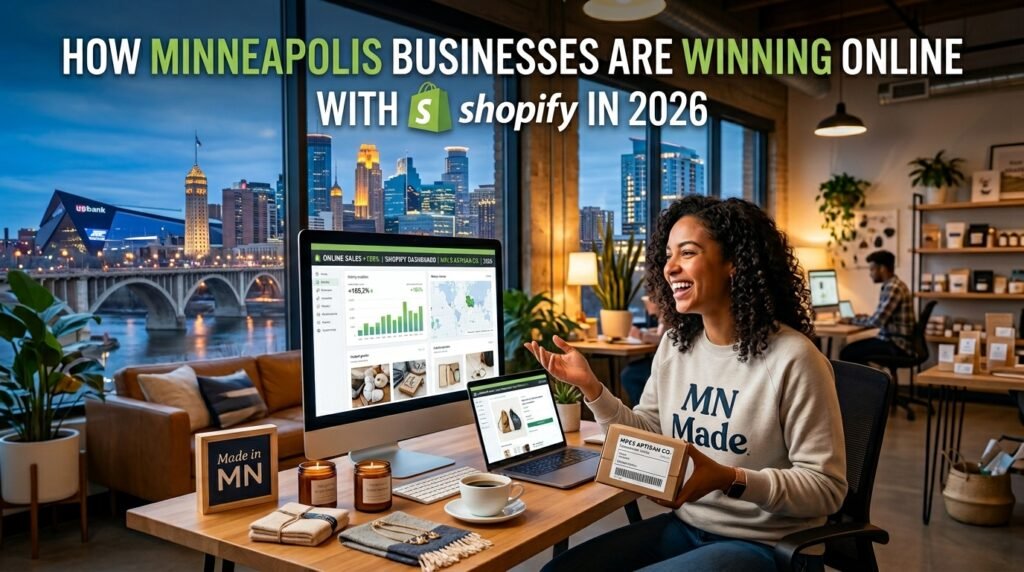
Shopify vs WooCommerce: Which Platform Actually Wins for Minneapolis Small Businesses in 2026?

Shopify vs WooCommerce: Which Platform Actually Wins for Minneapolis Small Businesses in 2026?

You’re running a small business in Minneapolis. Maybe you’re shipping candles from a studio in Northeast, selling custom gear out of a North Loop loft, or managing a hybrid retail-online operation near Uptown. You need an e-commerce platform that works as hard as you do, not one that crashes on a Tuesday when a local influencer tags your product.

So which is it? Shopify or WooCommerce?

Here’s the straight answer, built specifically for the Minneapolis in 2026.

Why Platform Choice Hits Different in Minneapolis

Why Platform Choice Hits Different in Minneapolis

Most platform comparison articles talk in abstractions. Cost. Scalability. Plugins.

That’s not useful if you’re dealing with MSP logistics quirks, Hennepin County tax configurations, or the reality that your warehouse in Mid-City Industrial gets buried in snow four months a year and your shipping windows shrink overnight.

Minneapolis businesses need an e-commerce platform that handles localized 1st-party data collection cleanly, integrates with regional shipping carriers without a fight, and doesn’t require a full-time developer every time you want to run a weekend flash sale.

Both Shopify and WooCommerce can technically do the job. But they serve very different operators.

Shopify: Built for Speed, Designed for Operators Who Can’t Babysit a Website

Shopify is a hosted platform. That means Shopify handles servers, security, updates, and uptime. You pay a monthly subscription, starting at $39/month for Basic, and you focus on selling.

For Minneapolis retailers transitioning from a physical storefront on Nicollet Mall to a full digital operation, Shopify removes the technical ceiling immediately.

Here’s what that means in practice.

Shopify POS integration in Minneapolis is seamless. If you’re running a hybrid model, a storefront in the North Loop plus an online store, Shopify’s point-of-sale system syncs inventory in real time. You’re not manually reconciling what sold at your Saturday pop-up at Calhoun Square against what moved online overnight.

Shopify also handles Hennepin County tax configurations automatically. Tax rates in Minnesota are layered, state, county, city. Shopify’s tax engine pulls the correct rates based on shipping destination without you manually building a tax table. For a small business owner in Minneapolis managing everything yourself, that’s hours back in your week.

Speed matters for Minneapolis SEO trends in 2026. Google’s ranking signals increasingly weight Core Web Vitals, page load speed, interactivity, visual stability. Shopify’s infrastructure is optimized globally through its CDN. Your Minneapolis customer on a phone at the Minneapolis Farmers Market loads your product page fast. That translates directly to conversion and organic ranking.

Shopify’s weakness? Customization has a ceiling. If you need deeply custom functionality, a complex B2B pricing model, unique product configuration logic, highly specific integrations with local Minneapolis-St. Paul regional shipping APIs, you’ll hit Shopify’s walls eventually. And when you do, you’re paying a developer to work around the platform rather than with it.

WooCommerce: Maximum Control, Maximum Responsibility

WooCommerce is a free WordPress plugin. The software itself costs nothing. What you pay for is hosting, security, premium plugins, and the time you or a developer spend maintaining everything.

For Minneapolis businesses with technical resources, an in-house developer, a retained agency, or a founder who genuinely enjoys the backend, WooCommerce offers capabilities Shopify can’t match.

Custom localized 1st-party data strategies are easier to build on WooCommerce. If you’re running a Minneapolis-based subscription business and you want to track hyper-specific behavioral data, build custom loyalty logic, or connect your store to a proprietary CRM in a way that Shopify’s app ecosystem won’t allow cleanly, WooCommerce is your platform.

Local SEO architecture is more flexible on WooCommerce. For businesses targeting Minneapolis SEO trends in 2026, specifically AI-personalized search results, neighborhood-level geo-targeting, and semantic content clustering for the best ecommerce platform Minnesota searches, WooCommerce on a well-configured WordPress install gives you more granular control over schema markup, URL structure, and content taxonomy than Shopify’s native setup.

Here’s the honest cost picture. WooCommerce looks free until it isn’t. Quality hosting runs $30–$100/month. Security plugins, premium WooCommerce extensions, backup systems, performance optimization, budget $150–$400/month minimum for a professionally maintained WooCommerce store. Add developer time for updates and troubleshooting, and a small Minneapolis business without technical staff can spend more time managing their website than managing their business.

How Each Platform Responds in 2026

How Each Platform Responds in 2026

This is where the comparison gets forward-looking.

AI-driven search in 2026 isn’t just about keywords anymore. Google’s Search Generative Experience and AI Overview features pull answers from structured, authoritative, locally-relevant content. For Minneapolis small businesses competing against national brands, your platform’s ability to support rich structured data, fast-loading personalized content, and localized signals matters more than it did two years ago.

Shopify is investing heavily in AI-native commerce. Shopify Magic, its AI toolset, now supports predictive product recommendations, automated SEO meta generation, and dynamic content personalization without third-party plugins. For a small business online store in MN that doesn’t have a marketing team, these tools lower the barrier to competing on personalization.

WooCommerce’s AI personalization story depends entirely on which plugins you’re running and how well they’re configured. There’s no native AI layer. Tools like Clerk.io, Barilliance, or custom-built recommendation engines integrate with WooCommerce, but each one is an additional cost, an additional maintenance point, and another potential failure node.

For predictive SEO specifically, the practice of building content that anticipates emerging search intent before it peaks, WooCommerce gives you more structural flexibility to implement semantic content clusters targeting North Loop retail tech audiences, Minneapolis-St. Paul regional shipping queries, or hyper-local commercial searches. But Shopify’s improving rapidly. Shopify’s new AI-assisted blog and landing page tools are closing the gap.

The Minneapolis Decision Framework: Who Should Choose What

Choose Shopify if:

You’re a Minneapolis retailer launching or scaling online for the first time. You run a hybrid in-person and digital operation and need Shopify POS integration in Minneapolis to work without friction. You want enterprise-grade security and uptime without hiring a developer. You’re generating under $2M annually and need to move fast rather than build custom.

Choose WooCommerce if:

You already have WordPress infrastructure and a developer relationship. You need deep customization for a complex product catalog, B2B pricing, or a highly specific local Minneapolis-St. Paul regional shipping integration. You’re willing to invest in technical maintenance in exchange for maximum control over your SEO architecture and data strategy.

The businesses we’ve helped transition from storefronts on Nicollet Mall to high-performance digital operations, most of them landed on Shopify Maintenance. Not because WooCommerce is inferior, but because operational simplicity compounds. Every hour you’re not managing hosting and plugin conflicts is an hour you’re talking to a customer, running a promotion, or building the local brand equity that no platform can manufacture for you.

FAQ: Shopify vs WooCommerce for Minneapolis Small Businesses

Is Shopify or WooCommerce better for small business SEO in Minneapolis?

For most Minneapolis small businesses, Shopify offers stronger out-of-the-box SEO performance in 2026 due to faster page speeds, automatic structured data, and built-in AI content tools. WooCommerce offers more flexibility for advanced local SEO strategies but requires technical expertise to execute correctly.

How does Hennepin County tax compliance work on Shopify vs WooCommerce?

Shopify automatically calculates Minnesota state, Hennepin County, and Minneapolis city tax rates based on shipping destination. WooCommerce requires manual tax table configuration or a paid tax plugin like TaxJar or Avalara to handle the same functionality accurately.

What is the real monthly cost of WooCommerce for a Minneapolis small business?

A professionally maintained WooCommerce store in Minneapolis typically costs $150–$500 per month when accounting for hosting, security, plugin licenses, and developer time. Shopify’s Basic plan at $39/month offers lower total cost of ownership for businesses without in-house technical staff.

Can I use Shopify POS for a Minneapolis retail storefront and online store together?

Yes. Shopify POS syncs in-store and online inventory in real time, handles split transactions, and generates unified sales reporting across both channels. It’s a strong fit for North Loop retail tech setups or any Minneapolis business running a hybrid physical and digital operation.

Ready to Choose the Right Platform for Your Minneapolis Business?

The platform debate is solvable. What’s harder is building a store that actually converts Minneapolis traffic, ranks for the searches your customers are running in 2026, and operates without eating your entire week.

If you’re a Minneapolis small business owner, whether you’re shipping artisan goods from Northeast, scaling a product line from a Mid-City Industrial warehouse, or moving a legacy retail operation online, the right platform is the one built around your operational reality, not a generic checklist.

Talk to a Minneapolis e-commerce expert who knows this market. Not a national agency running a cookie-cutter audit. Someone who understands why your January shipping delays aren’t a logistics failure, they’re a Minneapolis winter, and your platform and fulfillment messaging need to account for that.

Get a free Minneapolis e-commerce platform audit. We’ll tell you exactly which platform fits your business, your budget, and your 2026 growth targets, in plain English, no sales pitch.

Leave a Comment

Your email address will not be published. Required fields are marked *

Scroll to Top